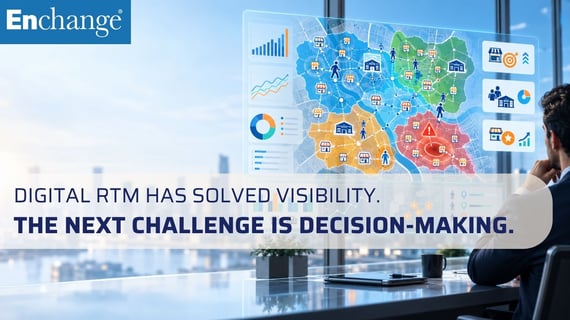
Digital Route-to-Market technology has transformed visibility across FMCG distribution. Businesses can increasingly see outlet performance, distributor activity, field-force execution, orders, stock movements and commercial performance at a level of detail that would have been difficult to imagine a decade ago.
But improved visibility creates a new challenge. Once you can see what is happening, you need to determine:
What should happen next?
- Which outlets deserve greater coverage?
- Which distributors require intervention?
- Where should routes or territories change?
- Which customers should receive direct sales coverage, and which could move to a lower-cost service model?
- Where should commercial resources be redeployed?
- And which interventions will genuinely improve growth, execution or profitability?
These are not primarily technology questions. They are Route-to-Market questions. And answering them may represent the next major frontier in digital RtM.
Digital RtM has become increasingly powerful
Today's RtM platforms can perform tasks that were previously difficult or impossible at scale.
They can, for example:
- digitise distributor operations;
- automate field-force routines;
- provide outlet-level visibility;
- track execution in near real time;
- identify gaps and anomalies;
- improve ordering and replenishment;
- connect data across fragmented distribution networks.
These capabilities have become essential foundations for modern Route-to-Market management. But they do not automatically determine the right commercial response. A platform might identify that distribution is declining in a particular territory. It might show that one distributor consistently performs below its peers.
It might reveal that sales representatives are spending disproportionate time servicing low-value outlets.
The technology can increasingly tell us what is happening.
The harder question is: What should the business do about it?
From visibility to commercial decision intelligence
Consider a distributor whose numeric distribution has fallen. The data tells us there is a problem. But several very different causes could sit behind the same metric.
- The distributor may lack sales capability.
- Its territory may be poorly designed.
- The outlet universe may be inaccurate.
- Call frequency may be inappropriate.
- The economics of serving the territory may no longer work.
- The portfolio may not match local market demand.
- Or the distributor itself may simply no longer be the right partner.
Each diagnosis requires a different intervention. The same is true at outlet level. An outlet with relatively low sales might need more frequent coverage.
Or it might need less. It could represent an untapped growth opportunity or be uneconomic to serve through a traditional field-sales model.
The data alone rarely answers that question.
The right decision depends on understanding the relationship between:
- market structure;
- channel dynamics;
- outlet segmentation;
- customer potential;
- cost-to-serve;
- distributor capability;
- field-force productivity;
- service levels;
- portfolio priorities;
- execution standards.
This is where deep Route-to-Market expertise becomes critical.
The next step in digital RtM is therefore not simply generating more information. It is developing the commercial decision intelligence needed to translate information into the right action.
The next generation of RtM platforms will increasingly need RtM logic
Historically, technology could focus primarily on recording, automating and displaying commercial activity. RtM strategy and commercial decision-making largely happened outside the technology. That boundary is beginning to change.
As digital platforms move from reporting towards recommendation, and increasingly towards AI-supported decision-making, they need to understand much more about how effective Route-to-Market models actually work.
For example:
- What constitutes an attractive outlet?
- What should determine its service model?
- When should coverage frequency change?
- What signals indicate structural distributor underperformance?
- When should a distributor be developed, and when should alternatives be considered?
- How should customer potential and cost-to-serve influence channel strategy?
- What constitutes good execution for different outlet segments?
- And which interventions are most likely to improve commercial performance?
These are increasingly questions that digital RtM platforms will be expected to help answer.
From systems of record to systems of action
The evolution of digital RtM can be thought of in four broad stages.
1. Digitisation
Replacing manual processes with digital ordering, field-force systems, distributor management platforms and connected commercial processes.
2. Visibility
Creating increasingly detailed insight into customers, outlets, distributors, inventory and field execution.
3. Intelligence
Using that information to determine which commercial interventions are most likely to create value.
4. Action
Turning those recommendations into practical changes in coverage, routing, distributor management, outlet priorities, resource allocation and execution.
Many organisations have made significant progress through the first two stages.
The next source of value lies increasingly in the transition from visibility to intelligence and action.
And that transition requires something technology alone cannot generate from data: a clear understanding of what good RtM looks like in different commercial contexts.
Teaching technology what “good RtM” looks like
Advanced analytics and AI can identify patterns at a scale and speed that human teams cannot. But identifying a pattern is not the same as understanding the right intervention. A technology platform may recognise that an outlet cluster is underperforming.
But what should the business do? Should it:
- increase call frequency;
- change assortment;
- adjust promotional activity;
- move the outlets to telesales or digital ordering;
- redesign sales territories;
- change distributor incentives;
- strengthen distributor capabilities;
- alter execution standards;
- or deprioritise the segment?
The right answer depends on context.
The same performance signal can lead to very different actions depending on the market, channel, customer economics, distributor model and underlying commercial objective.
In effect, the next generation of RtM technology will increasingly need to understand what experienced RtM practitioners have traditionally carried in their heads.
That creates an important opportunity. RtM expertise can increasingly be structured and codified into:
- methodologies;
- diagnostics;
- decision rules;
- benchmarks;
- algorithms;
- workflows;
- recommendation engines;
- AI models.
This does not mean that technology companies need to become traditional consulting firms. It means something more fundamental:
RtM domain intelligence increasingly becomes part of the technology itself.
So, what could this look like in practice?
Imagine an RtM platform that moves beyond reporting:
“Distribution has declined in these territories.”
and instead recommends:
“These outlet segments have sufficient potential to justify increased coverage. Moving from monthly to fortnightly calls is likely to improve distribution while maintaining acceptable cost-to-serve.”
Or instead of simply highlighting distributor underperformance, it identifies:
“This distributor's performance gap appears to be driven by execution capability rather than underlying market potential. Priority interventions should focus on coverage, field-force productivity and execution standards.”
Or rather than simply showing high servicing costs, it recommends:
“This outlet segment could move from field-sales coverage to telesales or digital ordering with limited revenue risk and a material reduction in cost-to-serve.”
This represents a fundamental shift. The technology is no longer simply recording the Route-to-Market model. It is helping the organisation diagnose and continuously improve it.
Why RtM expertise becomes more important, not less
It might be tempting to assume that advances in AI will reduce the need for specialist Route-to-Market expertise. The opposite may be true.
The more technology is expected to recommend actions rather than simply display information, the more important the commercial logic behind those recommendations becomes.
An AI model can identify correlations. But a commercially useful RtM recommendation needs to understand why those relationships matter, which variables should influence a decision, which trade-offs are acceptable and when apparently similar situations require different interventions.
That requires structured domain knowledge.
Across our work in Route-to-Market, one lesson appears repeatedly:
The same performance metric can require very different interventions depending on the RtM context behind it.
The opportunity is therefore not simply to put better analytics around existing commercial processes. It is to translate RtM experience, methodology and judgement into scalable commercial decision intelligence.
The next frontier for digital RtM
Over the coming years, we are likely to see RtM platforms develop increasingly sophisticated capabilities such as:
- automated outlet segmentation;
- intelligent coverage recommendations;
- dynamic route optimisation;
- distributor performance diagnostics;
- distributor governance workflows;
- next-best-action recommendations;
- execution-linked planning;
- cost-to-serve optimisation;
- AI-supported RtM diagnostics.
But the value of these capabilities will ultimately depend on the quality of the commercial logic behind them.
The winners in the next phase of digital Route-to-Market are therefore likely to combine three things particularly well:
data + technology + deep RtM domain intelligence.
Digital RtM has made enormous progress in showing organisations what is happening across their distributors, customers, outlets and field organisations.
The next challenge is more difficult — and potentially much more valuable: helping them decide what should happen next.
In the next article in this series, I will explore a question at the heart of that opportunity:
Can Route-to-Market expertise be codified?
In the meantime, I would really appreciate your comments.